
The Importance of Bespoke Acoustic Consideration When Working With Audio
The way sound waves interact with the surfaces of a room directly alters the listening experience within it. While sound is everywhere—and often an afterthought—in professional audio environments it becomes the primary focus. For producers, engineers, and audio professionals, an acoustically balanced space is essential to achieving an honest and accurate representation of sound. Bespoke acoustic design ensures that reflections, resonances, and frequency imbalances are controlled, allowing critical listening decisions to be made with confidence and trust in the room. As a result, acoustics should be a fundamental consideration when designing any professional listening or production space.
1. Sound Waves & Your Room
Understanding how sound interacts with the surfaces of your room is key to designing a suitable space. Equally, understanding the intended use of that space changes how we approach acoustic design.
An acoustically “dead” room often refers to a space with a low reverberation time (RT60)—the time it takes for the reverberant sound level to decay by 60 dB. In conventional studio control rooms, an RT60 of approximately 200–400 milliseconds across the frequency spectrum is often considered ideal. Due to the reduced presence of reflections, a “dead” room allows users to work with greater precision, as reflections are minimised and less likely to compromise the original, “true” direct signal.
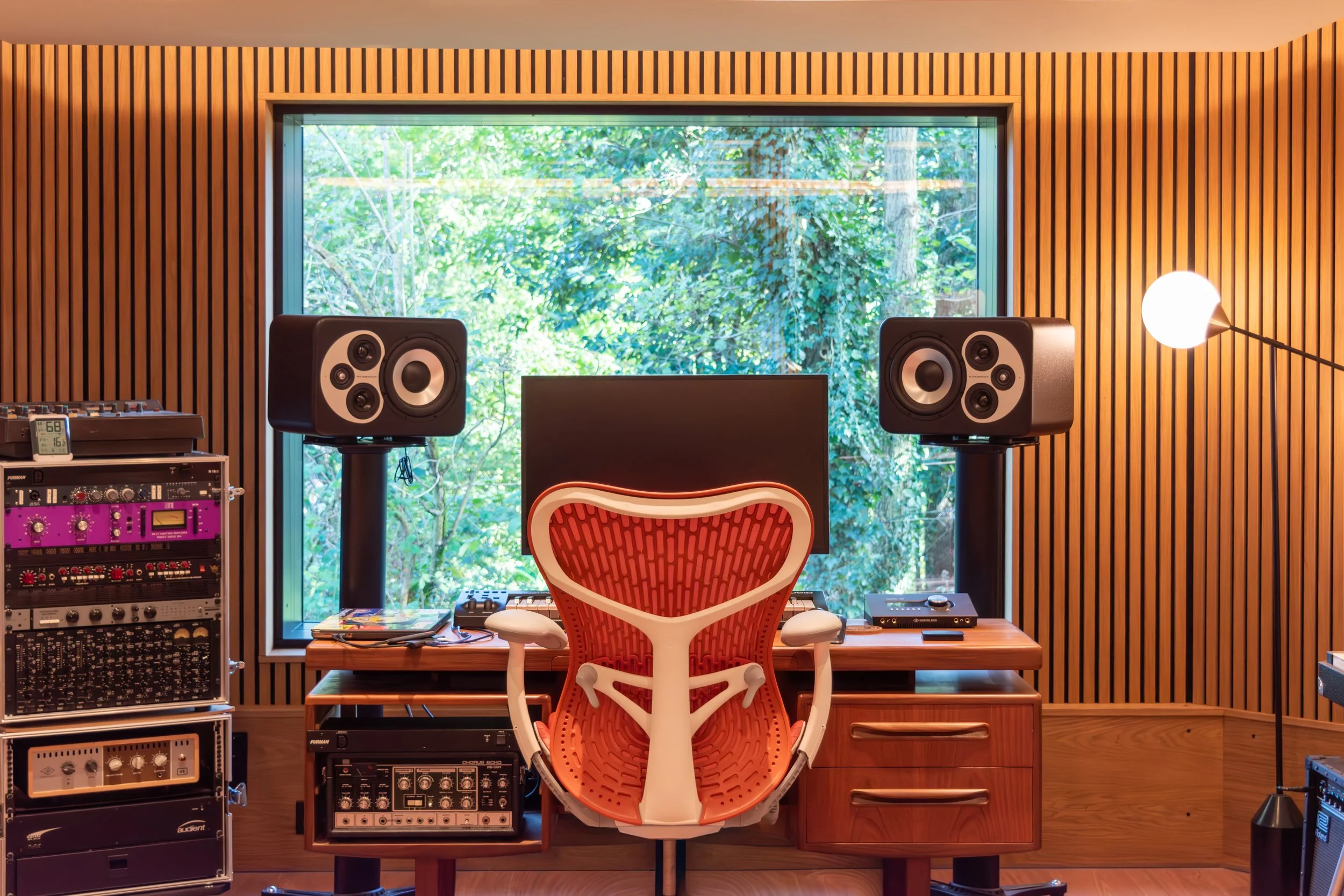
Sonic Box Studios - Bespoke Acoustic Design
However, this is not always the desired outcome. Often, we want a more neutral space—one where undesirable harmonics are limited and desirable harmonics are preserved or enhanced. Consider a rock band’s drummer: do they want their drums to sound completely “dead” and isolated, or “big” and “live”?
When referring to a “lively” space in recording studio acoustics, we are typically describing the controlled presence of desirable acoustic characteristics. This often involves a carefully managed increase in RT60, allowing certain frequencies to interact with the direct signal in a musically pleasing way.
This is commonly the difference between the control room and live room, the prior being a ‘dead’ environment built for critical listening, the latter being a multipurpose recording space to achieve a harmonically desirable recording.
2. Measuring Your Room
When designing a bespoke acoustic package, we typically model sound behaviour up to the fifth order of reflection, meaning we account for sound waves interacting with room boundaries up to five successive reflections. In practical room-acoustic design, higher-order reflections tend to arrive at significantly reduced levels and are increasingly diffuse, making them far less perceptually relevant for critical listening decisions. For this reason, modelling beyond this point offers diminishing returns in most studio environments.
The design process usually begins in a single plane, where we establish the relationship between the sound source and the listening position. To achieve a neutral and accurate stereo image, the listener and a pair of monitor loudspeakers are typically arranged in an equilateral triangle, creating a 60° total listening angle (±30° from centre). This geometry helps ensure balanced stereo imaging and consistent frequency response at the listening position, resulting in a setup similar to the example below.
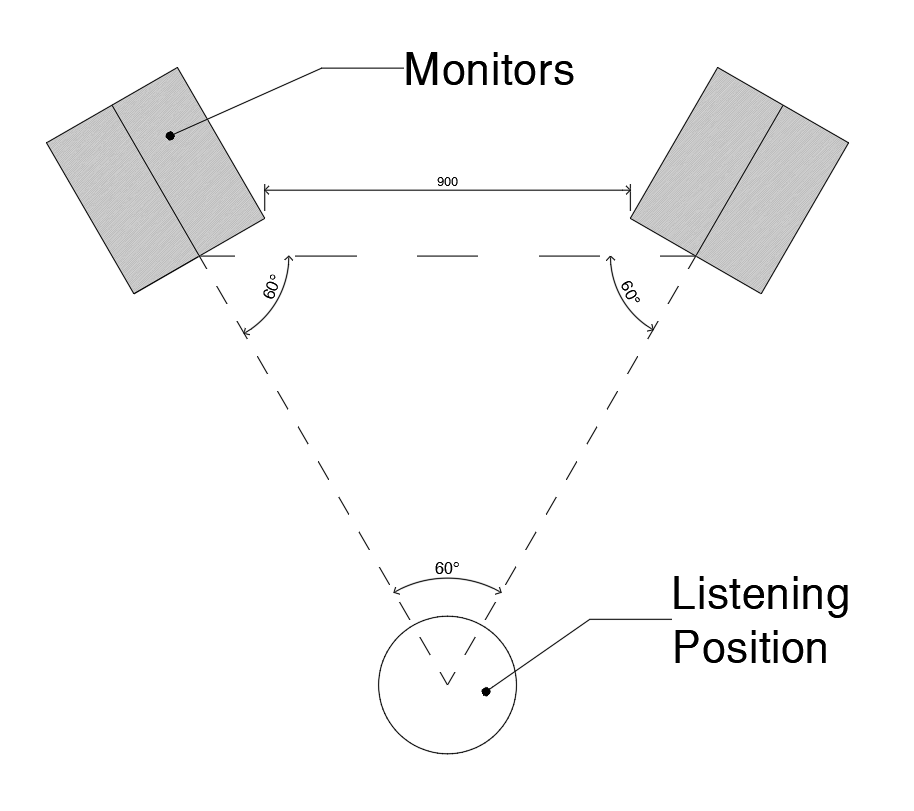
Sonic Box Studios - Listening Position
Once the direct sound path is established, we can begin to map how sound waves interact with room boundaries after leaving the source. To do this, we apply the law of reflection, which states that the angle of incidence equals the angle of reflection. Combined with distance-based calculations—such as level reduction described by the inverse square law—this allows us to predict where reflections will occur and how significant they are likely to be back at the listening position.
Using these principles, along with additional calculations to determine vertical behaviour, we can produce a reference reflection map for horizontal signals, similar to the example shown below.
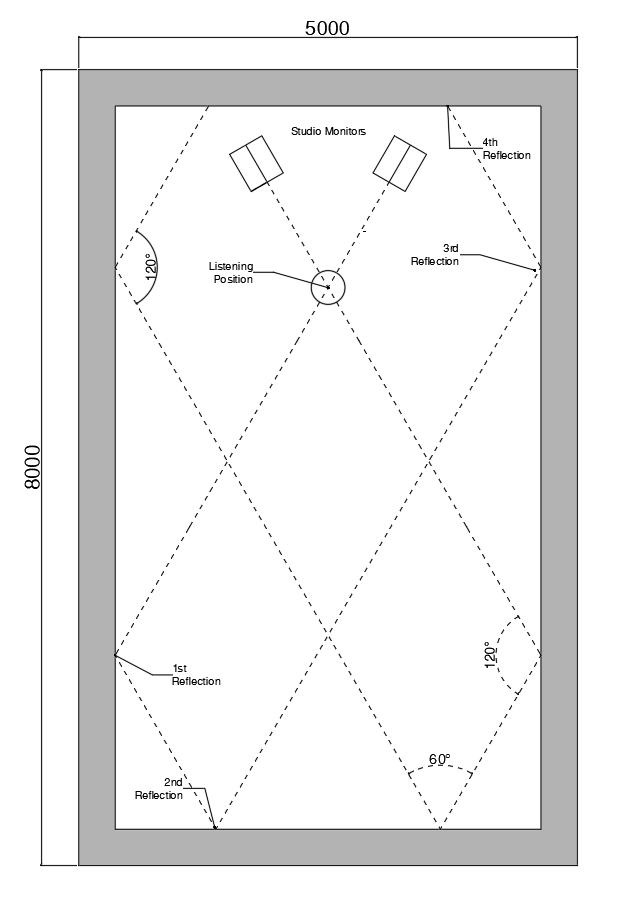
Using these principles, along with additional calculations to determine vertical behaviour, we can produce a reference reflection map for horizontal signals, similar to the example shown above.
While reflection maps are not always used directly in the final acoustic calculations, they are extremely useful from a practical design perspective. They help visualise how sound behaves within the room and provide valuable insight into how the space will ultimately sound, making them a helpful tool when designing an effective and balanced acoustic solution.
3. Accounting For Loss
Accounting for energy loss is one of the primary considerations in acoustic design. Once we have plotted how sound propagates within a plane, we can begin to examine the materials it encounters and measure the resulting exchange of sound pressure. Each surface interaction alters the sound wave based on the acoustic properties of the materials involved in the interaction.
Every material a sound wave encounters during a reflection has its own relationship with that wave, including absorption, reflection, and transmission energy to varying degrees. By understanding these material properties—often across multiple layers in professional recording spaces—we can predict the resulting sound signal after each interaction. This allows us to design an accurate and effective acoustic package that responds appropriately to the sound energy present at each stage of reflection.
To illustrate this concept at a fundamental level, the figure below shows a fictional material with equally fictional absorption coefficients across the frequency spectrum.
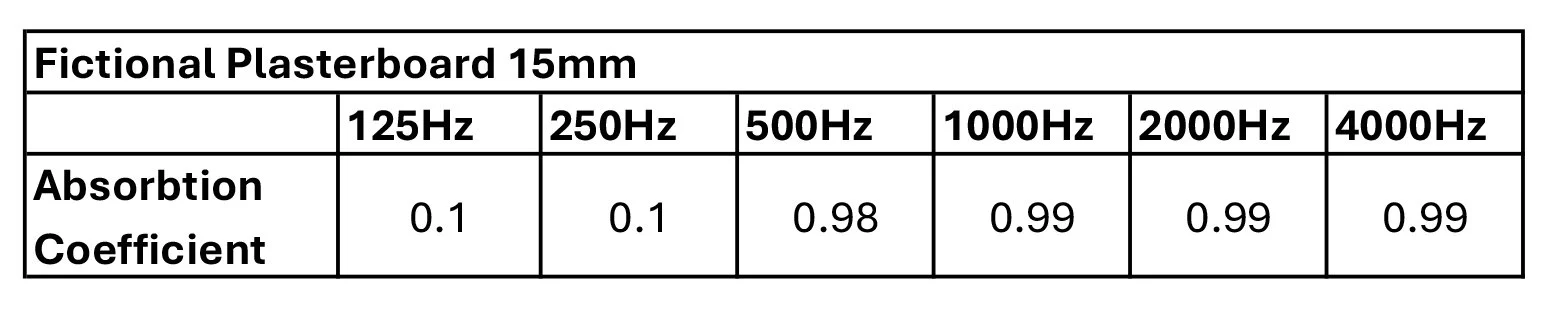
Sonic Box Studios - Plaster Absorption Coefficients
By calculating the reduction in sound pressure level (SPL) based on how much of the wave is absorbed, we can see that frequencies between 500 Hz and 4 kHz are absorbed far more effectively than lower frequencies between 125 Hz and 250 Hz. Referring back to the reflection map, this information allows us to design a targeted acoustic response at the second reflection point—specifically addressing problematic low-frequency energy that may prevent the room from maintaining a balanced frequency response and an accurate representation of the direct signal.
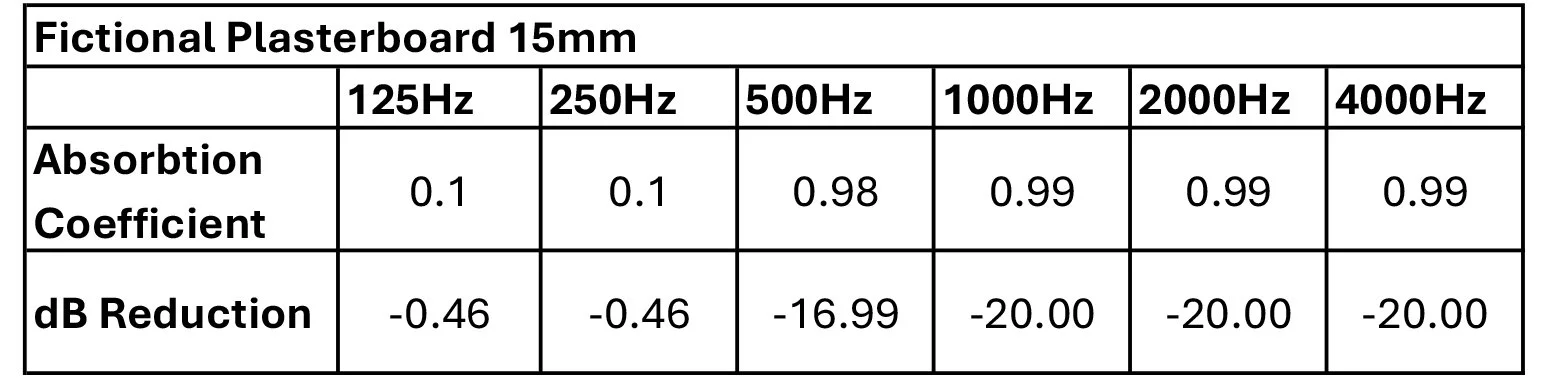
Sonic Box Studios - dB reduction across six frequency bands
It is important to note that this example represents just one interaction with a single material layer. In real-world recording environments, walls typically consist of multiple materials, each contributing to the overall absorption and reflection characteristics and therefore acoustic design. After each reflection, the sound wave continues to lose energy as it travels to the next boundary, experiencing further reductions in SPL due to both material interaction and distance.
This process repeats across all reflections within the room—horizontally and vertically—until the sound energy falls below the threshold of audibility. Accounting for these cumulative losses is essential to achieving a controlled, accurate, and predictable acoustic environment.
4. Addressing The Problem
To address frequency imbalances within a studio, we design and implement bespoke acoustic solutions tailored to the unique characteristics of each room—balancing function, practicality, and aesthetic design.
Once all relevant calculations have been completed and a comprehensive understanding of how sound behaves within the space has been established, targeted acoustic treatments can be implemented with a high degree of accuracy. This considered approach results in significantly improved sonic performance, creating a controlled, reliable environment for critical listening and creative work.
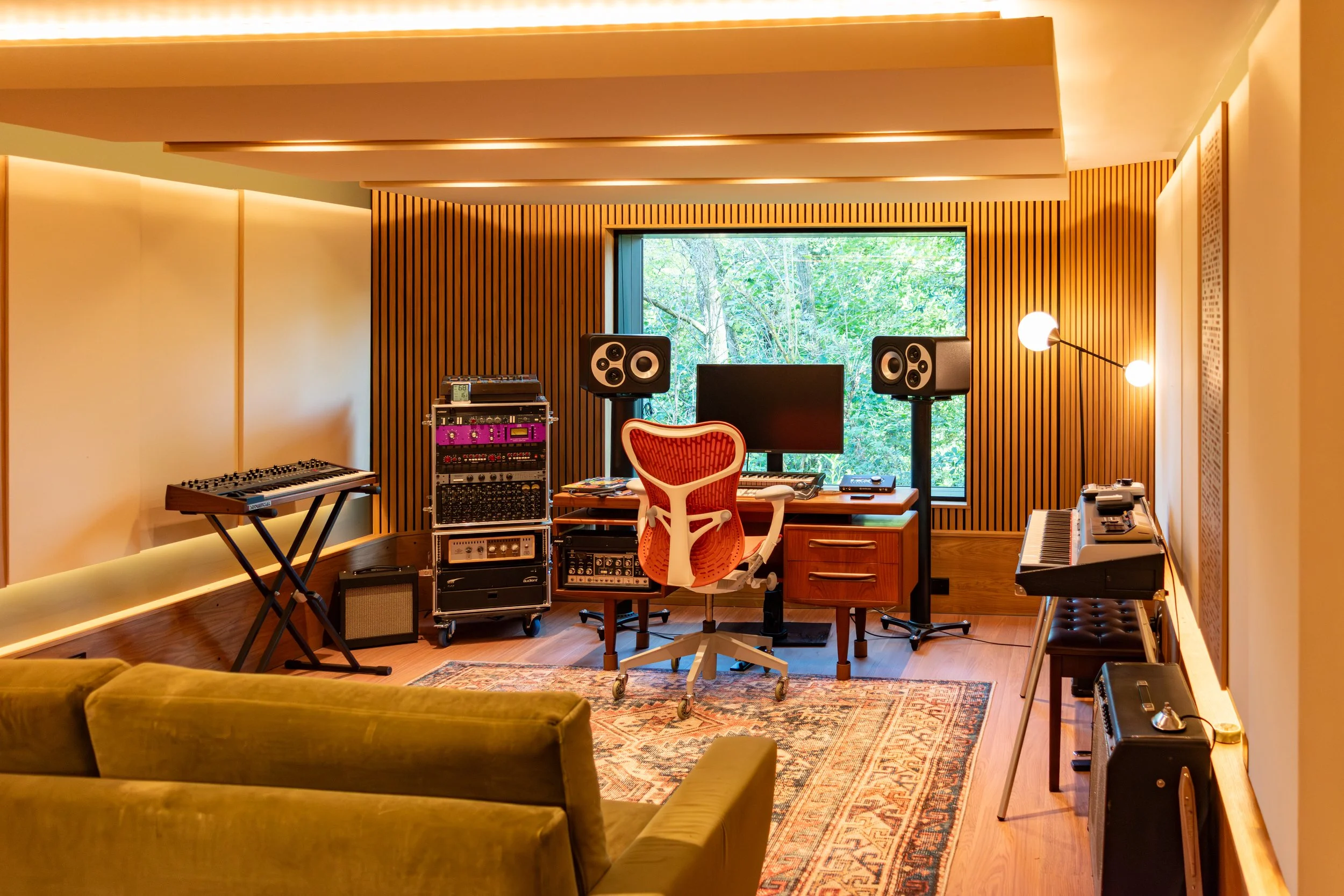
Sonic Box Studios - Bespoke Design with Tailored Acoustics
5. Real-World Acoustics: Why Does This Matter To Me?
In untreated or poorly treated rooms, common acoustic issues often go unnoticed until they begin to affect your decision-making. Bass frequencies may build up in corners, mid-range detail can become smeared or muddied by reflections, and the overall stereo imaging may become inconsistent depending on the listening position. These issues can lead to mixes that don’t translate well outside the studio, resulting in lost-time by unnecessary revisions, or ultimately audio that doesn’t sound as good as it could.
By addressing room acoustics properly, engineers, producers and audio professionals can trust what they are hearing. Speeding up workflow, improving accuracy, reducing listening fatigue, and harvesting a more enjoyable and productive creative environment.

To conclude - acoustic design plays a critical role in how accurately we hear and interpret sound within an enclosed environment. By understanding how sound interacts with a room, accounting for reflections and energy loss, and applying tailored acoustic solutions, we can create environments that support confident and informed listening decisions. Ultimately, bespoke acoustic treatments ensure that a studio works with the sound in harmony, rather than against it—allowing creativity and precision to coexist under the same roof.
