
Soundproofing
Whether you are a musician, producer, podcaster, content creator or a gamer, soundproofing is a key factor when considering which type of studio or outbuilding you select for your garden. At Sonic Box Studios we have a range of different specifications with different levels of soundproofing to suit your specific requirements.
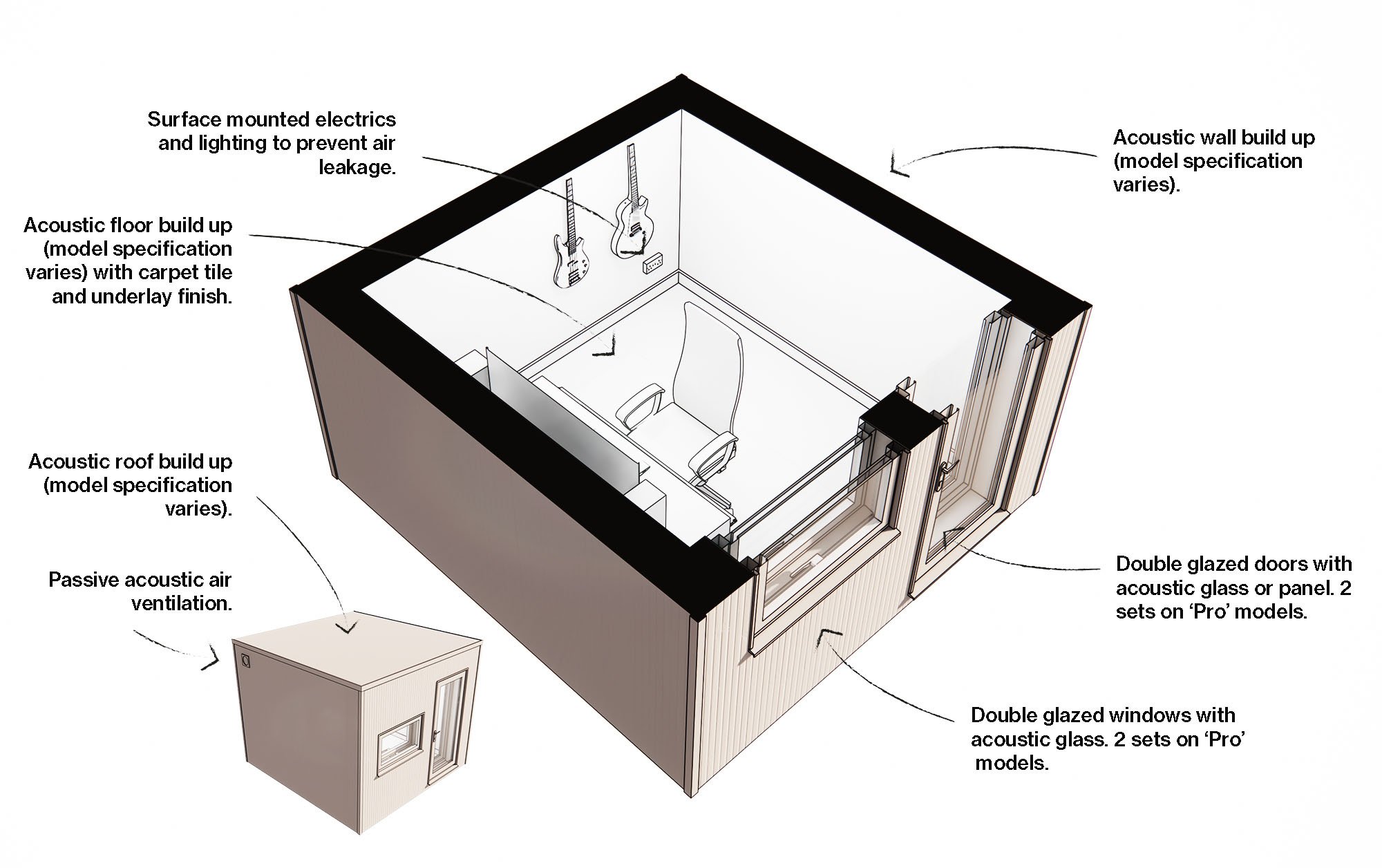
Walls, Roof & Floor
Soundproofing involves creating a boundary which reduces a soundwaves ability to freely pass through walls, ceilings, floors and glazing. We achieve this via a combination of techniques such as adding mass, decoupling materials, creating air gaps, and increasing the amount of porous absorption.
One technique we use in all out builds is the installation of high performance insulations such as mineral wood between the studs/joists in the walls, floor and roof. Porous absorbers such as mineral wool help absorb sound waves - reducing their ability to freely pass the boundary, therefore reducing it's level on the other side. This, couple with increasing mass to make it more difficult for the sound waves to travel through the denser materials is one technique used to appropriately contain sound.
Another technique we often use is decoupling. This involves creating airgaps between material build-ups, preventing them from directly contacting each other. By doing this - we're creating an airgap between build-ups where soundwaves can further reflect freely to reduce the pressure they hold within an enclosed, porous environment that is not within the main studio, nor directly passing through to the exterior of the build.
We also use high quality membranes to prevent unwanted vibrations - and add mass to the walls.


Doors & Windows
Any door or window creates an opening within the studio, breaking the seal of the soundproof barrier. Leaving the area the weakest part of the structures soundproofing defence.
To counteract this, we offer a number of different solutions to improve the soundproofing capabilities of these specific points. These include, installing double (or triple) glazing with acoustic glass, using a double door and window system as featured within our SB-3 & SB-4 specifications, and using non-opening windows.
As standard, we provide a passive acoustic ventilation system. Allowing for natural airflow in and out of the build - excluding the requirement to for an opening window. This is perfect for music studios and rehearsal spaces where you can compromise the soundproofing performance. We can also provide passive baffle box systems, and acoustic air conditioning systems, allowing the studios to be mechanically temperature controlled all year long.

Electrics & Lighting
In all of our Sonic Box Studios your lighting, switches and sockets are surface mounted to prevent air leakage, which in turns increases the soundproofing performance. All of the work is completed by a certified electrician to Building Regulations standard, with a certificate issued after completion.

Acoustic Treatment Vs Soundproofing
Depending on the size, specification or use of your Sonic Box Studio - you may wish to apply an acoustic treatment design to the space.
Acoustic treatment is designed to improve how sound interacts with out waves and ultimately the listener within a room. Differing to soundproofing, which focuses on reducing the ability of soundwaves to enter travel through the walls.
Acoustic treatment entirely focuses on controlling the sound that is within the room. This involves adding additional materials to absorb, reflect and diffuse problematic sound waves. The aim here is to create an optimal listening environment - allowing the monitoring within the studio to be an honest depiction of the audio true characteristics, without enhancing or reducing the presence of particular frequencies - leading to unintended mix or recording decisions.